Monday, June 7, 2010

Durban's Waterfront

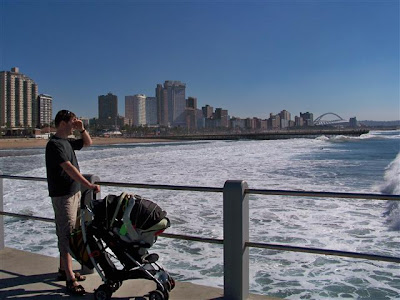
This past Thursday was a beach day. We drove down to Durban’s waterfront where they have a 6 km promenade along the Indian Ocean shores. It was a gorgeous day, 25 degrees and sunny. The sand was golden, and the ocean blue with a dramatic white crested playground for surfers.

We had a lovely walk on the paved promenade.

Meanwhile...back on the homefront

We have now been away from home for three full weeks. In almost exactly one week, to the hour that I’m writing this, we will hopefully be arriving home. We will be back to our two girls, Sara and Leah, from whom we’ve been away for so long.

Being separated from our daughters has been difficult, but much better than I expected. They have been well cared for by our parents, their Opa and Oma and Grandma and Grandpa, and have been doing all sorts of special things. From riding the bus just for fun, to horseback riding, the beach, picnics by the river, and the splash pad, they have been spoiled in the way that only Grandparents can.

There are several things that we have done to make this time apart easier for all of us. We left a “handbook” for our parents on the girls’ routines, friends, contact numbers etc. just so things will be easier for them. We bought and wrapped a little gift for the girls for every three days while we are away. We gave them little things like a Tim Horton’s card to celebrate Jeremy’s adoption day, a movie and microwave popcorn, smarties and hair ties, and things to keep them busy like modelling clay, paints, and craft supplies. Finally, the best thing that we did to prepare for being apart from our 3 and 6 year old is to set up Skype accounts. Both Opa and Oma and Grandma and Grandpa are set up with a webcam, mic and Skype account, as are we. Every other day or so, usually around 10pm our time, 4pm Canadian time, we go on Skype and talk with our girls. It has been wonderful! They show us crafts that they have made, hairstyles that Grandma has been experimenting on them, news of soccer games, and little events of the day. They have heard about our experiences, and most of all, get to see their little baby brother (although he usually is asleep). Skyping has really been what has kept us going. In fact, the times when separation has been the most difficult has been the times when we are unable to get online. The time in Johannesberg was particularly rough since we had a five day stretch without contact.

Since then, though, for the most part we’ve had regular contact and it’s so great to see Sara and Leah’s happy cheerful faces before we go to bed at night.

We’re on the home stretch. One week to go, and three of those days will be spent travelling. The countdown is on!

Friday, June 4, 2010

With Glowing Hearts...

One of the most stressful things about this South African adoption process is the timing. Leaving our two oldest children in Canada is one of the most difficult things I have ever done. Obviously, this anxious mom doesn't want to be away from them any longer than I absolutely have to. Robyn also has a goal to get us out of this country as soon as possible so that we don't get bogged down with the World Cup. So...under her advice, we booked our flight home for June 10. Exactly three weeks and one day in South Africa. Three weeks to adopt a baby, get his Canadian Citizenship and then his Canadian passport. Robyn warned us...it'll be tight.

Immediately after the adoption, on May 19, we filled out the application for Jeremy's citizenship. Robyn gave us the passport application before we left for the Drakensberg mountains and I had been meaning to get to work on them, but hey...I was on holidays and you can't send them in until you are granted citizenship anyway! Finally, on June 2, when we were back in Durban, I took them out to look at them and began filling them out. There was quite a bit to fill out and a lot that we didn't know the answers too, (Jeremy's weight and length for instance -- they just don't supply hotel rooms with ways to get that information). We decided to go to the mall to take a break and to get some things.

I don't know why I did it. I was not expecting the call at all, but I gathered up all our papers, put them in the laptop bag and took them along with us. At 3:45, just outside the photo shop, our cell phone started ringing. Robyn, our social worker, was calling to tell us the happy news. Jeremy's papers were here. We need to us, our passport paperwork, Jeremy's passport pictures and the required fee to the lawyers office by 4:30!

PANIC!

Remember the timing issue? Remember the anxious mom who doesn't want to stay in South Africa, beautiful as it is, any longer than I absolutely have too? We need to file these papers today! It was great that our citizenship papers were through, that was one step in getting us out of the country, but we still have the passport to go. That takes on average 4-5 days, unless something happens like the printer breaks (which has happened to Robyn in the adoption process two times). If we could get the paperwork together by 4:30, that would give us an extra day.

Providentially, we had brought our paperwork with us. But what about the required fee? Like the obedient tourists we are, we never carried much cash with us, just in case. Almost all of our money stays locked up in our hotel room. We did not have a chance of getting back to our room and then off to the lawyers. It was time to try our BANK CARD.

Getting money is difficult in South Africa. Several Canadians that we had talked to had not had any success in using an ATM, regardless of which bank they tried. We contacted President's Choice Financial before we left and they made it very clear to us that our cards might not work...

They didn't. Not at the first bank. I raced through the mall looking for a second bank...and there it was, NED Bank, and no line up. Hands shaking with sheer adrenaline, my card went in, I selected chequing, 600 Rand and the machine started to whirl...there was my cash...we were ok.

I muttered a quick Hallelujah under my breath and raced back to the car and jumped in. It was now 4:10. But wait...we need petrol...(South African for gas)...no time...we'll chance it. Geraldine, our wonderful GPS, guided us turn by turn through the busy Durban streets, onto highways, off highways, while I did my best to fill in our forms and remind Marc which side of the road to drive on...at every intersection. Finally, we heard those wonderful words, "You have reached your destination" and the clock said 4:30...
We piled out of the car, grabbing the laptop bag, the diaper bag, the papers I was working on, our wallets (OH NO!! WE DON'T HAVE OUR PASSPORTS!) I look at Marc in panic and he is out of breath with the stress of it all. Well, can't do anythingn about it now; we'll see what happens.

Now to find the building. We found a building with the number 225 on it. An Indian restaurant. We decided maybe the lawyer's office was located above the restaurant...We climbed the stairs and rang the bell at the gate at the top. No answer. Now what?

At 4:40, after ten minutes of walking around. Robyn called us again, "Are you guys alright?" she said. Hearing our dilemma, she directed us to the proper building and there we were.
Apologizing for our poor timing, our unfinished paperwork, and our stressed condition, we shook hands with our lawyer and got to work.

"Passport please?" he said. My heart sank. And then, Robyn, bless her heart, said, "I have them here." "What?" I thought, "you have them?" And there she showed the certified photocopies of our passports that we had brought with us from Canada. And that did it.

I have no idea what Robyn wrote down for Jeremy's height and weight. She sized him up and took a guess. I have no idea how long the courier was waiting to bring the Jeremy's passport application to the airport to get on the 6:00 pm flight, but I know it was after 5pm when Robyn put it in his hands.

It wasn't until we had made it through ABSOLUTELY CRAZY Durban rushhour traffic and had sat down in our hotel room that it hit us. Jeremy is a Canadian! I hugged my little guy, placed him on my lap and sang "O Canada" from start to finish, while he stared at me with is amazing Canadian eyes! And my heart was glowing...

Wednesday, June 2, 2010

A Tour Through Soweto

Yesterday we toured the township of Soweto, a huge city with a population of 2 million officially, but more probably 4 million. We were picked up from our apartment by “Jacques” our Afrikaans tour guide and with his constant and informative chatter descended into Soweto.

Both Marc and I were a little nervous about going to Soweto. We had been advised not to go there unaccompanied, and never to go there at night (actually, never to go anywhere at night). We also had heard so many stories of the poverty of the slums we were not sure how we would handle seeing such miserable living conditions.

What surprised us is that Soweto is a city. It has stoplights, curbs, and street signs just like any city. Major roads are paved and stores and gas stations and schools and hospitals rise up along them. This was not what we expected.

What is strange is that beautiful brick houses and affluent areas exist right across the road from the most awful slums. These slum houses are made completely of corrugated steel, wood, cardboard, blankets, any thing that could be used as a form of shelter. And in these areas you see men, women, teenagers and babies living. Somehow they are living in that filth, and dilapidated conditions. And then you turn a corner and you see beautiful housing complexes. It is shocking.


Some neat things we saw were outdoor barbershops, shebeens, and little stores at the side of the road, something we discovered was typical of Soweto.


Our guide took us to various sights in Soweto. We went to the square in Kliptown where the Freedom Charter was signed. A document signed by blacks, coloureds, and Indians stating clearly what the aims of their resistance were. The square traditionally was a place where people traded goods, sold trinkets and food and gathered socially. And still today it is used for that purpose, but it also holds a huge monument and plaques telling the story of the Freedom charter.

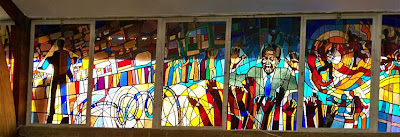
From there we went to the Regina Mundi Catholic Church. This was the meeting place of the ANC during the uprisings. The government had banned the political groups and made it illegal to meet. They had not, however, banned church. So the resistance leaders would meet in the church, have a brief service and then hold their meetings. The police, however, got wind of this and they raided the church during their meetings. Their gunshots are still in the bricks and windows of the church, and a corner of the alter table is broken where a police officer struck it with his rifle butt. In the stain glass windows of the church, the story of the resistance is told. Including stain glass depictions of Nelson Mandela and Hector Peterson who, with other children was shot by police during a peaceful school children’s demonstration.


The balcony of the Regina Mundi church was transformed into an art gallery displaying photographs of the story of Soweto, life under apartheid, the resistance movement, and Sowetan life in general. Throughout the years, visitors have signed their names and other messages all over the walls of the gallery, it was interesting to read what people had written.

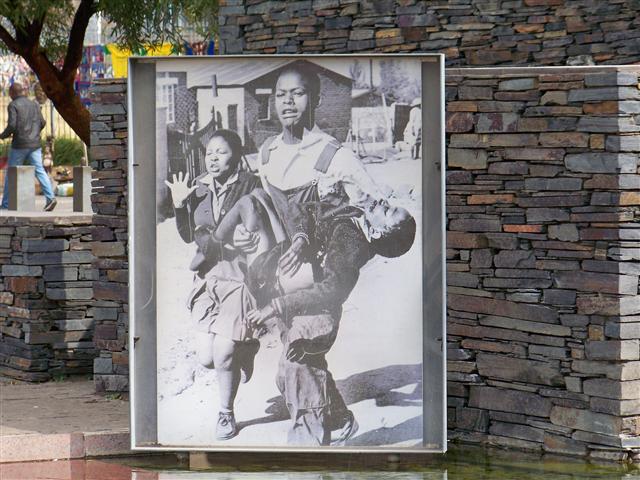
We also went to the Hector Peterson Memorial and museum. This was a moving experience as we were presented the story of school children who were demonstrating about having to be educated in Afrikaans instead of their first language. While peacefully walking to present their case to the government, the police told them to disperse and when they refused the police opened fire, killing and injuring many children. Hector Peterson was an 13 year old boy who was killed and then photographed being carried by a man with his sister following. This picture was shared throughout the world and Hector became the face of the anti-apartheid movement. In fact, the boy who was carrying Hector had to go into hiding and eventually had to flee South Africa because he was hunted by the police.


Finally, we visited Nelson and Winnie Mandela’s house in Soweto which has been converted into a museum. It is a very simple house – a living area and kitchen attached, a bedroom, washroom and a den which was converted into the children’s bedroom. It was neat to stand in the room where Nelson and Winnie had lived. The house had been firebombed several times and there were bullet holes in the brickwork from the times that the police had come to arrest them.


After Mandela’s house, we had a quick glimpse at Desmond Tutu’s house (he still lives in Soweto, as does Winnie Mandela), a sneak peak at Soccer City despite its tight security and then we headed back home to our apartment in Sandton.

The Road to Equality

On Saturday, we spent three and a half hours learning about apartheid in the Apartheid Museum. The building is quite impressive, designed to be symbolic of the struggle of the blacks in Africa, and the long road to equality. When you purchase tickets, you are given passes saying “European” or “non-European” and then you must enter through separate gates depending on your card. As you walk through the gate there are huge replications of passbooks, a necessary document blacks had to carry on them when in white areas or fear imprisonment. After a long uphill journey, symbolizing the long uphill road to justice, you enter the museum.
We were treated to an historical overview of the entire history of apartheid, beginning with the discovery of gold in Johannesburg which led to migrant black miners, through the development of the city slums, the relocation of black people into townships, and the 1948 ruling which made apartheid law. The museum did a good job contrasting the lives of blacks and whites in South Africa during apartheid and also showing the propaganda perpetrated by the government to strengthen their position. It then showed the incredible fight of black resistance to fight for their right for equality under the law.

One jaw dropping moment was when we watched a video of the architect of apartheid, President Verwoerd defend apartheid. He called it “good neighbourliness”, the whites and blacks living separate lives as good neighbours. It was almost disgusting to hear him speak, and all the people applaud.

The museum also had a temporary exhibit on Nelson Mandela which was interesting. I never realized how traditionally Xhosa Mandela had been raised. It’s amazing to see the story of his life told so completely.

The museum was a sobering experience. We left it with our emotions raw, our heads reeling and our minds puzzled as to how this could ever have happened. We also left with a prickling mind about Jeremy. This is part of his story, both sides of it. Jeremy is bi-racial, his parents experienced apartheid on different sides of the fence, one as the privileged, the other as the sufferer. How do these two sides of him come together when faced with this history? Where does Jeremy fit into this story? This baby, who slept the entire time tied to my chest, has no idea about this part of his identity. It will be our job to help him come to terms with this two-sided history, and indeed the two-sided identity which he holds.

Tuesday, June 1, 2010

Jeremy Goes to Johannesburg

This past weekend we spent in Johannesburg, We piled all our suitcases, diaper bag, computer, cosmetic bag, all our luggage back in our little hatchback and made it into Johannesburg just before rush hour. Jeremy, bless his little heart, slept the whole way, which was a real answer to prayer as we were very nervous about driving in the big city traffic.


We stayed at Sandton Suites, an apartment complex that rents out some of its apartments as a hotel. So…we had a kitchen, eating area, living room, two large bedrooms with two ensuite bathrooms and a large outdoor patio. The place seemed huge! After being cooped up in hotel rooms for the last 2 weeks it felt very strange. We realized that since we had picked up Jeremy from the baby house, we had not been further than two metres away from him. It was a strange thing to put him down for a nap and then leave the room to cook supper in the kitchen or watch TV in the living room. He seemed so far away from us!Jeremy is doing wonderfully! He is such a smiley happy baby. He is nursing well, sleeping well, travelling well and he is so sweet. One advantage of having an apartment we realized, is that there are more options for Jeremy. Until now, he was either in his carseat, on the bed, or in our arms. We missed things like baby swings, exersaucers, and bouncy seats. But in Johannesberg, suddenly there was a couch! Wow! We soon got used to sitting him in the corner of the couch with a big pillow across his lap for support. That allowed him to sit up and look around, and look at the books and toys we propped up in front of him.


Jeremy is getting stronger daily too. He holds his head up like a pro, and has now begun to “stand” a little on his legs. Until now, when we held him up, he did not put any weight whatsoever on his legs. It’s neat to see him change.

First impressions of Johannesburg are it's hectic and busy, and it is made up of walls. There are high walls around everything. Every house, store, school, office building, shopping plaza, everything has at least a six foot high wall, most topped with barbed wire or electric fencing. As a result, it doesn't feel like an inviting city. You don't see houses or store fronts, instead it's like driving down a hallway. It takes a little getting used to.
We only had a short time in Johannesburg, but we feel like we’ve done all the important things that we had hoped to do. We went to the apartheide museum on Saturday, Church and the Bruma Market on Sunday, and toured Soweto on Monday. (More to come of those experiences.)

Right now we are leaving Johannesberg (yes, I’m typing in the car), and are on our way back to Durban. Hopefully, cross your fingers, Jeremy’s citizenship papers are ready and we can move on to his passport application.

Monday, May 31, 2010

How Now Shall We Live?

On the winding mountain road to Cathedral Peak, there is a rural African community. In our time in the mountains we drove through this community several times on our way into town and to various sites in the area. Each time, we were glued to the windows, watching this completely foreign, completely other-world life that we were passing through.

The first thing that strikes the traveller is the people. The people are walking up and down the mountain road, to school, to work, to the river for water, to neighbours. This narrow, windy, dangerous road is covered with people regardless of what time you drive it. The women all have children tied to their backs by heavy blankets or cloths, they hold the hands of older children or sit with them at the side of the road. They carry tremendous loads of branches on their heads, bringing them home for their cooking fires. Huge containers of water are transported on the their heads for drinking. Groceries, laundry, boxes, all sorts of things are placed on their heads with their children on their backs as they walk slowly up the mountains to their huts.


For huts are what their homes are, round little huts with grass roofs. Their yards are dirt with laundry drying in the sun on the fences and rocks. Some huts have concrete block buildings with them and rocks keep the corrugated steel roofs from blowing away.
We passed women and girls washing their clothes by hand in the river, boys herding goats and cattle along the road way, and uniformed school children playing on their way home from school.

Our first encounter with this community was total shock. How could such poverty, such misery exist in our world? How can it be the neighbouring community to the four star luxury of Cathedral Peak Hotel? How do we look these people in the eye as we pass through them, or return their enthusiastic waves and thumbs up signs in our direction?

Each time we passed through the community, we saw a little more, a little deeper into their lives. First of all, they seemed happy. Tired perhaps from their long walks and hard work days, but smiling and joking, and even singing as they worked. We noticed that they were well clothed, women in dresses, men in pants and sweaters, all without rips or tears. We noticed the hydro wires connected to their grass roofed huts, and we even saw some satellite dishes.

These people live simply, without running water or flush toilets, but they have access to phones, a local hospital, and several schools. These people are poor, but they are ok.

The juxtaposition of the rural African community and the luxury hotel creates a stark, hash view of the reality of South Africa. Traditional, simple, poor living for many, and extreme luxury for a few. It is difficult to handle, and difficult to digest.

When my brother Paul was in South Africa last year, he asked his host, how they could live with such disparity in their country. Their host responded, "Well, how do you?".

That is a question with which we are struggling during this time in South Africa. I hope it will be one which we continue to struggle with the rest of our lives.